
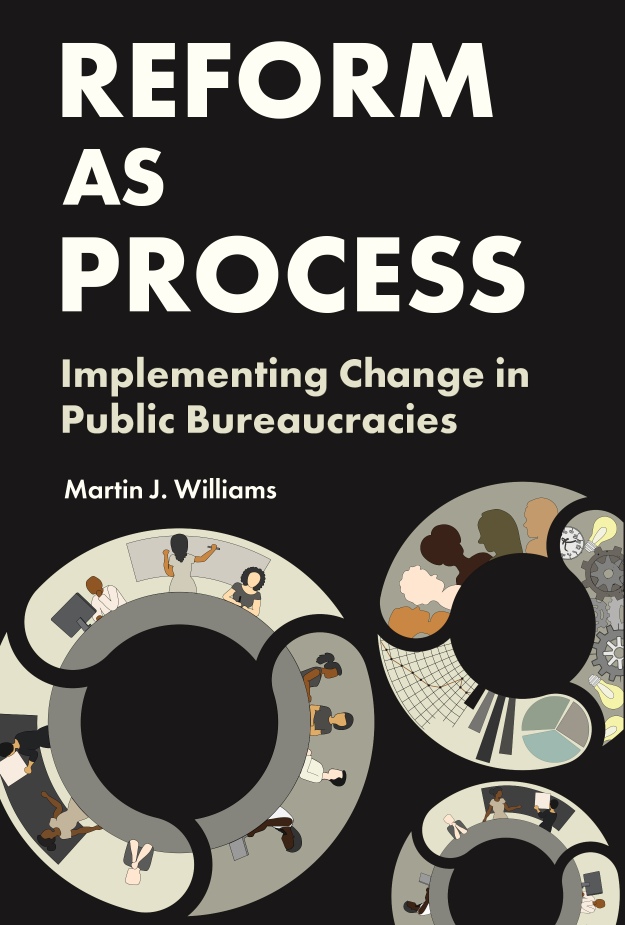
Reform as Process:
Implementing Change in Public Bureaucracies
Building an effective civil service is crucial for public service delivery and good governance, but reforming bureaucratic institutions is notoriously difficult. This book takes a fresh perspective on this challenge by documenting and analyzing the implementation of more than one hundred reforms initiated by six African countries over the last thirty years. These reforms largely fell short of their goals because they typically approached organizational change as a matter of changing formal structures and processes through one-off projects. However, many of these reform efforts did yield positive changes when they were able to create energy and opportunities for civil servants to discuss performance and how to improve it. I draw on this evidence to develop a theory of how systemic reforms can lead to meaningful change not by trying to force it through top-down interventions, but by approaching reform as an effort to catalyze an ongoing and decentralized process of continuous improvement. The book makes theoretical and empirical contributions to research on organizational performance, civil service reform, and public service delivery, and discusses practical insights and strategies to help reformers around the world achieve meaningful change in their organizations.
Now available for purchase from Columbia University Press (use code CUP20 for 20% off), Powell’s, Amazon, and other booksellers. A free PDF download is also available here or here.
A short policy brief on the book’s findings and recommendations is available here.
The book’s supplementary bibliography (digital only) is available here.
Shortlisted for Douglass North Best Book Award by the Society for Institutional and Organizational Economics.
In this smart and approachable book, an emerging star explains why administrative reforms succeed and fail. The book gives us evidence-based answers and distills the findings into a handful of sensible principles to help us achieve successful reforms in diverse contexts. This book has changed the way I think about durably improving public sector performance.
David Lewis, author of The Politics of Presidential Appointments: Political Control and Bureaucratic Performance
Why some reforms succeed while others fail has been the subject of scholarly debate for years. In this book, Martin J. Williams makes a unique contribution to this debate with an insightful comparative methodology and engaging writing style.
Joseph R. A. Ayee, author of Reforming the African Public Sector: Retrospect and Prospects
This book provides a fantastic combination of scholarly and practical insights on how to (and how not to) implement reforms in public bureaucracies. Based on a decade of comparative research, it is a must-read for both scholars and practitioners interested in building state capacity and improving government effectiveness anywhere in the world.
Karthik Muralidharan, Tata Chancellor’s Professor of Economics, University of California, San Diego
In Reform as Process, Martin Williams offers a clear, evidence-based playbook for building capable bureaucracies in Africa and beyond, making the book a necessary addition to any bookshelf for public administration scholars and practitioners alike.
Mai Hassan, author of Regime Threats and State Solutions: Bureaucratic Loyalty and Embeddedness in Kenya
Reform as Process provides sweeping evidence from six African countries in a brilliant account of how government reform can work—by starting a conversation—in Africa and worldwide.
Alisha Holland, author of Forbearance as Redistribution: The Politics of Informal Welfare in Latin America
In this masterful work, Williams shows why so many well-intentioned bureaucratic reforms fail and how they can succeed when treated as a process of collective, continuous learning rather than a one-off, top-down intervention. This book is a must-read for practitioners, policymakers, academics, and anyone interested in meaningful policy reforms.
Adnan Khan, Professor, London School of Economics
Government reform efforts are a graveyard of good ideas. Reform as Process seeks to break this cycle, offering a pragmatic but hopeful guide on how to empower public servants to better serve the public. A masterful distillation of theory, research, and the hard lessons of practice that provide insights essential for anyone who cares about government performance.
Donald Moynihan, coauthor of Administrative Burden: Policymaking by Other Means
This brilliant book offers an alternative to the ambitious but failing reforms imposed on public servants around the world. Instead, Martin Williams presents an alternative proven path to excellence through empowering and motivating public servants collectively to learn by doing. It’s a must-read for all those who aspire to better government.
Ngaire Woods, dean of the Blavatnik School of Government, University of Oxford
In this impressive book, Martin Williams combines theory and evidence to show that government reform doesn’t come from new rules or grand plans—it comes from changing what bureaucrats do every day. Williams explains that reforms fail when they ignore the realities of everyday work and offers an understanding of how to make real change happen—as a persistent, human process, not a project.
Matt Andrews, Professor, Harvard Kennedy School
 Martin J. Williams